Rebuilding the Skin Barrier After Inflammatory Conditions: A Practical Perspective
Cosmetologist’s Guide to Post-Inflammatory Skin Recovery.

The Barrier: No Longer an Afterthought
We tend to assume that once inflammation is gone, the skin has healed. In practice, that is almost never true. The redness clears, the breakouts disappear, the client feels satisfied and yet the skin barrier can remain compromised for months: thinned, dehydrated, and hyperreactive. It is precisely in that gap between looks healthy and actually is healthy that the next flare-up is quietly taking shape.
This shift in understanding that the barrier does not simply suffer from inflammation, but actively
participates in it is, in my view, the most important development in our field over the past several years. Barrier dysfunction was once attributed to
individual skin sensitivity and largely left at that. Today, it is increasingly recognized as a measurable,
manageable parameter one that deserves the same clinical attention as the inflammation itself.
In my practice, I work within a barrier-oriented
framework I call BOAA™, built around the staged
restoration of the skin’s protective function and the gradual reintroduction of active therapy.
Why Inflammation and the Barrier Form a Closed Loop
The relationship between the skin barrier and
inflammation is not one of cause and effect it is a cycle. Inflammatory conditions acne, rosacea, atopic or
seborrheic dermatitis, psoriasis degrade the lipid
structure of the stratum corneum, deplete ceramides and free fatty acids, and increase transepidermal water loss. A compromised barrier, in turn, becomes more
permeable to irritants and microbial antigens,
triggering further inflammation. The barrier is not a casualty of the disease. It is part of its mechanism.
What Happens After the Breakouts Clear
Remission is not the same as recovery. This is the distinction I find myself explaining to clients more than any other.
Visible symptoms resolve faster than barrier function restores and most relapses hide in exactly that window. The skin looks calm but remains reactive: sensitive to weather changes, a new moisturizer, even tap water.
I have seen this pattern repeatedly in my practice. One patient, after successfully treating her acne,
discontinued all moisturizing care the moment her skin appeared clear. Three weeks later, she returned with pronounced irritation, a burning sensation, and new inflammatory lesions. The cause was not a relapse of her condition it was barrier breakdown. Her skin had been left without support at precisely the moment it needed it most.
Five Principles of Modern Barrier Therapy
What has evolved in recent years is not so much the ingredient list as the logic behind how we use it. My clinical approach is built on five core principles.
One: Lipid replenishment as a system, not a single ingredient.
Products that combine ceramides, cholesterol, and free fatty acids in physiological ratios consistently
outperform those that isolate one component. The ratio matters as much as the ingredients themselves.
Two: Restoring moisture through the skin’s own Natural Moisturizing Factors, not occlusion alone.
In my experience, formulas containing amino acids and urea deliver more durable results in chronic dryness than heavy, occlusive textures which often mask the problem rather than address it.
Three: Adjusting active therapy rather than eliminating it.
My consistent advice to colleagues: do not remove the active ingredient reduce the load. Alternating with barrier-supportive care and gradually increasing frequency is far more effective than swinging between extremes.
Four: Supporting the skin microbiome.
The evidence base here is still developing, but clinically I see a clear pattern: clients with significant dysbiosis tolerate even gentle active therapy poorly until microbiome balance is at least partially restored.
Five: Daily SPF the step patients most consistently skip during recovery.
In my clinical experience, skipping sun protection during the post inflammatory period is one of the most common reasons visible improvement stalls for weeks longer than it should.
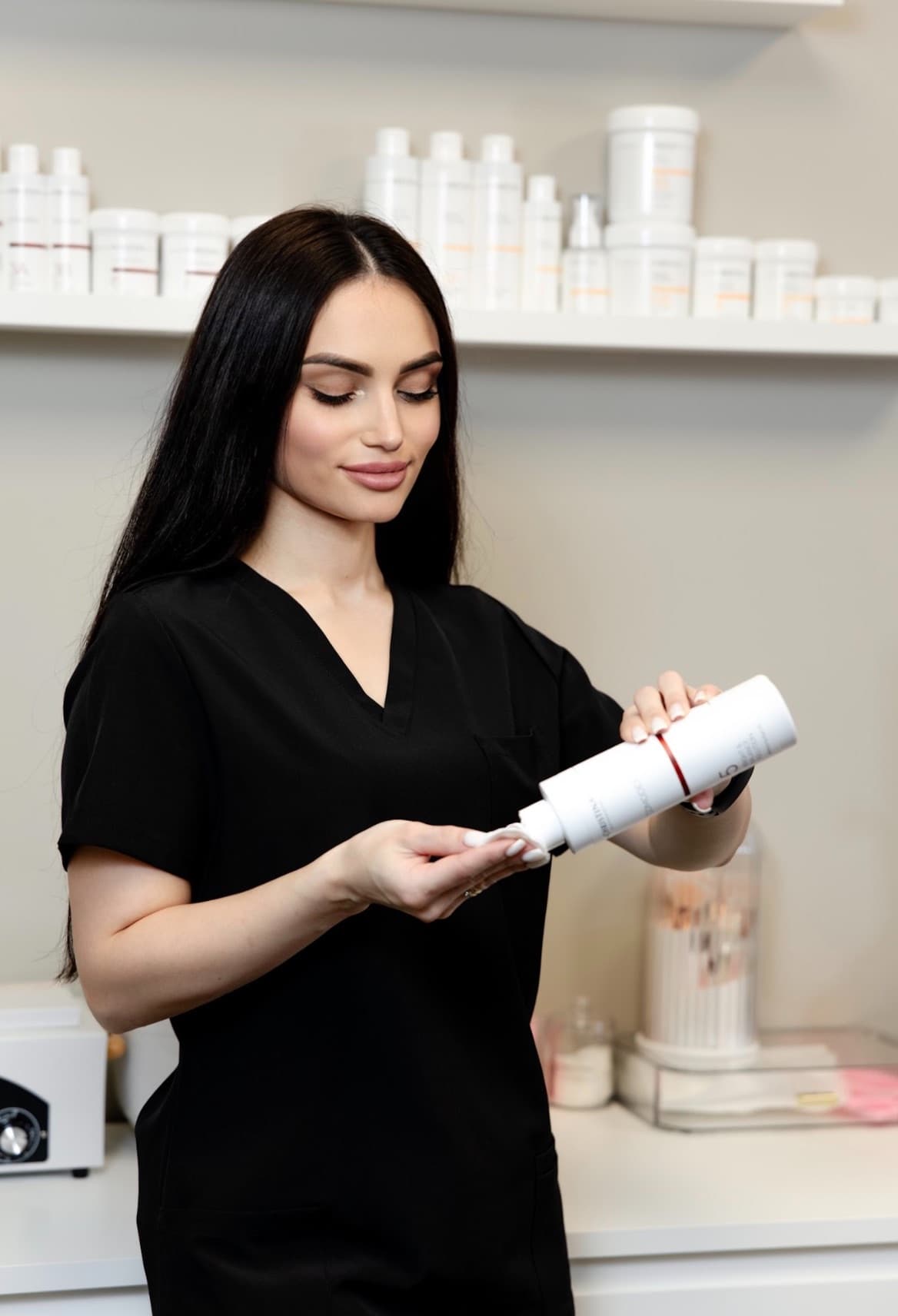
“The barrier does not simply suffer from inflammation. It actively participates in it.”
What I Assess at the First Consultation
A thorough intake informs everything that follows. The five areas I focus on:
1. Visual signs of barrier dysfunction — flaking, reactive erythema, microfissures
2. Subjective complaints — tightness, burning, itching, even when the skin appears clinically calm
3. Recent changes in home care — not only what has been prescribed, but what has actually been used
4. Tolerance of previous therapy — whether there were episodes of irritation and how they were managed
5. External factors — climate changes, new products introduced, stress levels, and daily skincare habits.
A pattern I have observed consistently: most patients assess their skin’s condition exclusively by the presence or absence of
breakouts. But subjective sensations
tightness, sensitivity, a low-grade burning frequently appear before any visible changes, and they are often the earliest signal that the barrier has not yet recovered. I give these complaints equal clinical weight to the
objective presentation.

The Mistakes Patients Make Every Day
The most common: rushing back to aggressive treatments the moment inflammation subsides. Peels, retinoids at full
concentration, device based procedures the result is almost invariably the same: new irritation that reads as a relapse, when in reality it is the consequence of reloading a barrier that was never given the chance to fully restore.
The second most common: abandoning all moisturizing and
barrier supportive care as soon as breakouts clear, on the
assumption that healthy looking skin needs nothing further.
The third: relying exclusively on the mirror and ignoring
physical sensation. Burning and tightness almost always
precede visible changes and they are the signal worth listening to first.
A Closing Thought
We are treating isolated symptoms less and working with skin physiology more. That is precisely why barrier restoration is no longer the conclusion of a treatment protocol it is an essential part of it.
The measure of successful treatment today is not only how quickly inflammation was resolved, but how fully the skin’s physiological defenses were rebuilt. The barrier is the
foundation on which lasting remission, therapy tolerance, and genuine quality of life are built.
_______________________________________________
Author
Anzhelika Syveniuk
MD (Ukraine), Licensed Esthetician