
The Lab Has Won: How Clinical Beauty Took Over the Industry
Clean beauty had its moment. Now science is running the show.
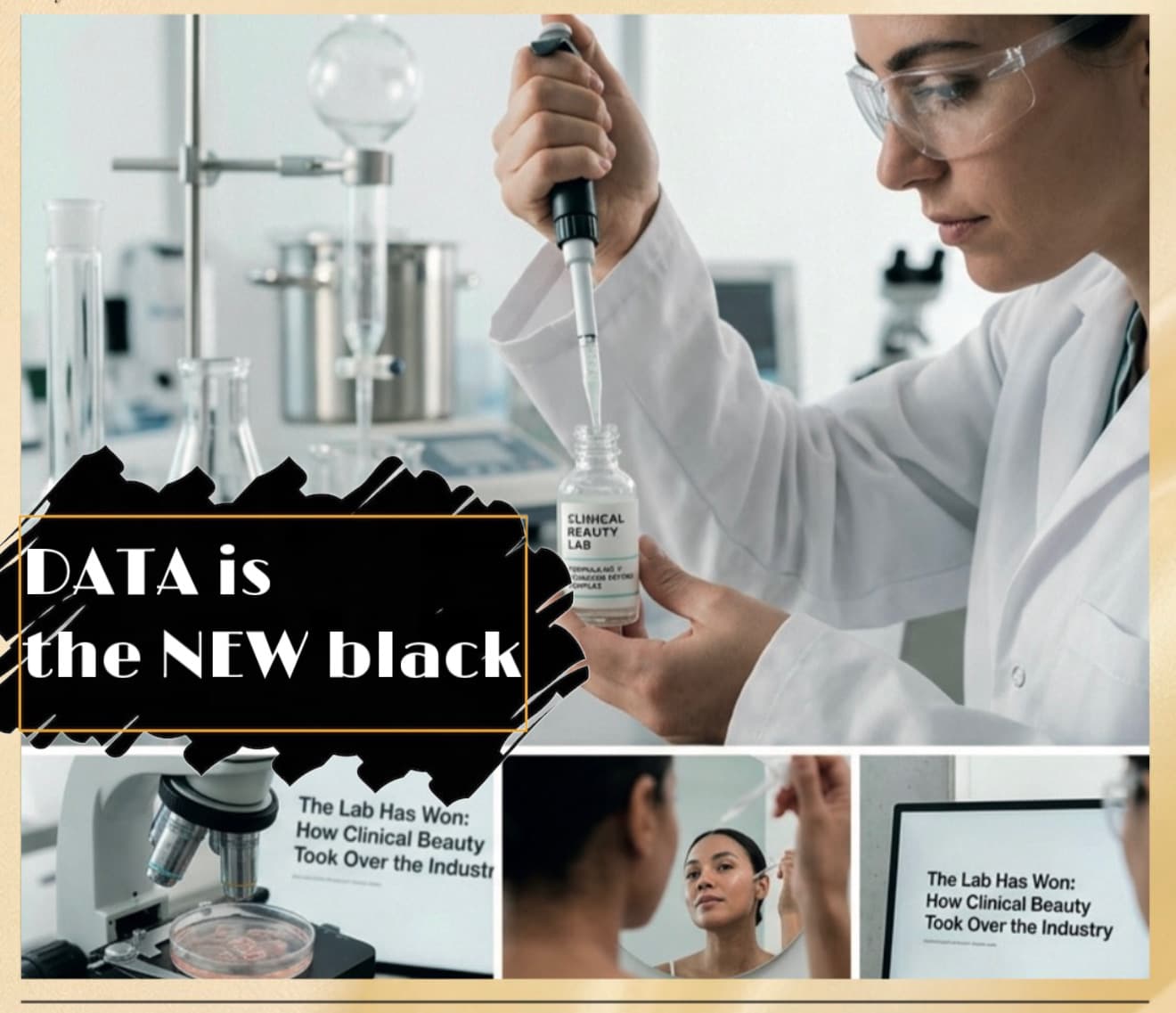
There was a time not so long ago when the most powerful word in beauty was natural. Brands competed over who could boast the longest list of banned ingredients. “Free from” became a full marketing strategy. Consumers memorized the EWG database like scripture. And somewhere along the way, a serum that smelled of lavender and listed five recognizable botanicals felt safer, smarter, more right than anything formulated in a laboratory.
That era is over. Not quietly, not gradually but decisively, with the kind of industry-wide pivot that only happens when consumer behavior and scientific advancement collide at exactly the right moment. Welcome to the age of clinical beauty: precise, evidence-based, and completely uninterested in your feelings about synthetic ingredients.
From the Farmer’s Market to the Lab Coat
The clean beauty movement was never really about chemistry. It was about trust or rather, the lack of it. Consumers didn’t know what was in their products, didn’t trust the brands that made them, and reached for “natural” as shorthand for “safe.” It worked. For years, it worked beautifully. But trust is a moving target. And somewhere between the tenth “toxic-free” moisturizer that did absolutely nothing and the third dermatologist explaining why your all-botanical routine was causing breakouts, the consumer calculus shifted.
People stopped asking what’s not in it and started asking what does it actually do. The phrase that’s been circulating in boardrooms, R&D labs, and brand strategy decks across the industry captures it perfectly: “Consumers want proof, not promises.” And they mean it. Clinical trial data, peer-reviewed research, before-and-after protocols these are no longer optional marketing add ons. They are the baseline expectation.
The Science That Changed Everything
Clinical beauty isn’t just a trend. It’s a structural shift in how products are developed, marketed, and validated. And it’s being driven by several converging forces. Biotechnology has arguably been the biggest disruptor. Ingredients that once existed only in research papers are now appearing on shelves at Sephora. Lab fermented compounds, biosynthetic actives, and precision-engineered molecules have given formulators tools that nature simply cannot replicate at scale, with consistency, without ecological cost. The result: products that are both more effective and, paradoxically, often more sustainable than their “natural” predecessors. Derm validated formulas have become the new gold standard. The dermatologist co-sign once reserved for medical-grade skincare is now everywhere, because consumers have learned to look for it. Brands without clinical backing are quietly losing ground to those who can show the data. And then there’s skin-tech: the category that’s rewriting the relationship between hardware and skincare entirely.
Your Bathroom Is Becoming a Lab
The at-home beauty device market has exploded and not just in revenue. In sophistication. LED therapy masks that replicate in-office protocols. Microcurrent devices calibrated for facial muscle stimulation. AI-powered skin scanners that assess hydration, pigmentation, and barrier function before recommending your next serum. The consumer who once dropped $300 on a “detoxifying mud mask” is now investing the same amount in a device that delivers measurable, trackable skin improvement. The shift isn’t just in what people buy. It’s in how they think about beauty altogether as a practice with outcomes, not a ritual with vibes. This is what skin-tech has accomplished: it’s turned skincare into a discipline.
“The next frontier in beauty isn’t a new ingredient — it’s a new standard of proof. We’re entering an era where a clinical study is worth more than a celebrity endorsement.”
— Dr. Alexis Granite, Consultant Dermatologist & Clinical Advisor, speaking
The Ingredients Everyone Is Talking About
If you want to understand where clinical beauty is heading, watch the ingredients. Four categories are dominating conversation, research investment, and consumer fascination right now.
Exosome skincare is perhaps the most exciting frontier. Exosomes nano-sized vesicles that carry biological signals between cells are being explored for their potential to accelerate regeneration and communicate with skin at a cellular level. Still emerging, still evolving, but already generating the kind of industry buzz that retinol did in the ’90s. Peptide cosmetics have moved from niche to mainstream, and the science has matured with them. No longer just “signal peptides” in anti-aging creams, peptides are now being engineered for specific targets: barrier function, collagen synthesis, inflammation modulation. The category is becoming as sophisticated as pharmaceutical R&D. Longevity beauty is the concept that’s quietly transforming how the entire industry thinks about aging. Informed by longevity medicine senolytics, NAD+ pathways, mitochondrial health this isn’t anti-aging in the traditional sense. It’s about extending the health span of skin, not just masking the visible signs of time. The consumer who reads Dr. David Sinclair is the same consumer now looking for these concepts in their skincare. Brands that understand this are building the next decade of the category.
And finally, beauty supplements have finally grown up. The ingestible beauty space long dismissed as wellness theater is now backed by clinical data on collagen peptides, ceramides, astaxanthin, and microbiome-targeted formulations. The inside-out approach isn’t a metaphor anymore. It’s a protocol.
Data is the new black
What This Means for the Industry
The implications of this shift extend far beyond ingredient decks and marketing copy. Clinical beauty is reshaping the entire professional landscape. For estheticians and skincare specialists, the pressure to understand the science behind treatments not just the technique has never been higher. Clients come in with lab results, screenshots of ingredient analyses, and questions that require real knowledge to answer. The most successful professionals in this space are those who’ve embraced continuing education as a non-negotiable.
For brand founders and formulators, the era of launching on aesthetic alone is over. A beautiful campaign and a charming founder story can still open doors but without efficacy data, the consumer isn’t staying. Investment in R&D is no longer a luxury brand decision. It’s a survival strategy. For retailers and buyers, the shift is equally significant. The question is no longer “does it sell?” but “does it work?” and increasingly, the former depends entirely on the latter.
The Nuance We Can’t Ignore
It would be too easy and frankly, too reductive to frame clinical beauty as simply “winning” over clean beauty. The reality is more interesting. The consumers driving this shift are not abandoning their values around sustainability, ethical sourcing, or environmental impact. They’re adding a new requirement: efficacy. The brands that will define this decade are those that can hold both simultaneously formulas that are scientifically rigorous and responsibly made. Biotech, in many ways, offers exactly that possibility. Clean beauty didn’t lose because it cared about the wrong things. It lost because it stopped being honest with consumers, and with itself.
The lab has won. Not because science defeated nature, but because consumers evolved past the binary. They want to understand what’s in their products, why it works, and how it was proven. They want results they can measure, not a feeling they can only describe. Clinical beauty isn’t cold. It isn’t sterile. At its best, it’s the most intimate thing a brand can offer: a promise it can actually keep.
And in an industry built on transformation, that might be the most revolutionary thing of all.
_______________________________________________
Author
Valeriia Kizchuk
Beauty journalist and industry observer covering the intersection of science, aesthetics, and culture in modern beauty.